

Introduction
Professional Tax (PT) is a state-level direct tax imposed on individuals earning income through employment, profession, trade, business, or any other occupation. Unlike Income Tax, which is levied by the Central Government, Professional Tax is governed and collected by individual state governments.
For employers, HR professionals, payroll managers, and business owners, understanding Professional Tax compliance is crucial to avoid penalties and ensure smooth statutory compliance.
What is Professional Tax?
Professional Tax is levied under Article 276 of the Constitution of India, which empowers state governments to collect tax on professions, trades, callings, and employments. The maximum Professional Tax that can be charged from an individual is ₹2,500 per year.
Professional Tax applies to:
- Salaried employees
- Self-employed professionals
- Freelancers and consultants
- Proprietorship firms
- Partnership firms
- Companies and LLPs
- Traders and business owners
Employers are responsible for deducting Professional Tax from employee salaries and depositing it with the respective state government. Self-employed professionals must obtain Professional Tax Enrollment and pay the applicable tax directly.
States Where Professional Tax is Applicable in India
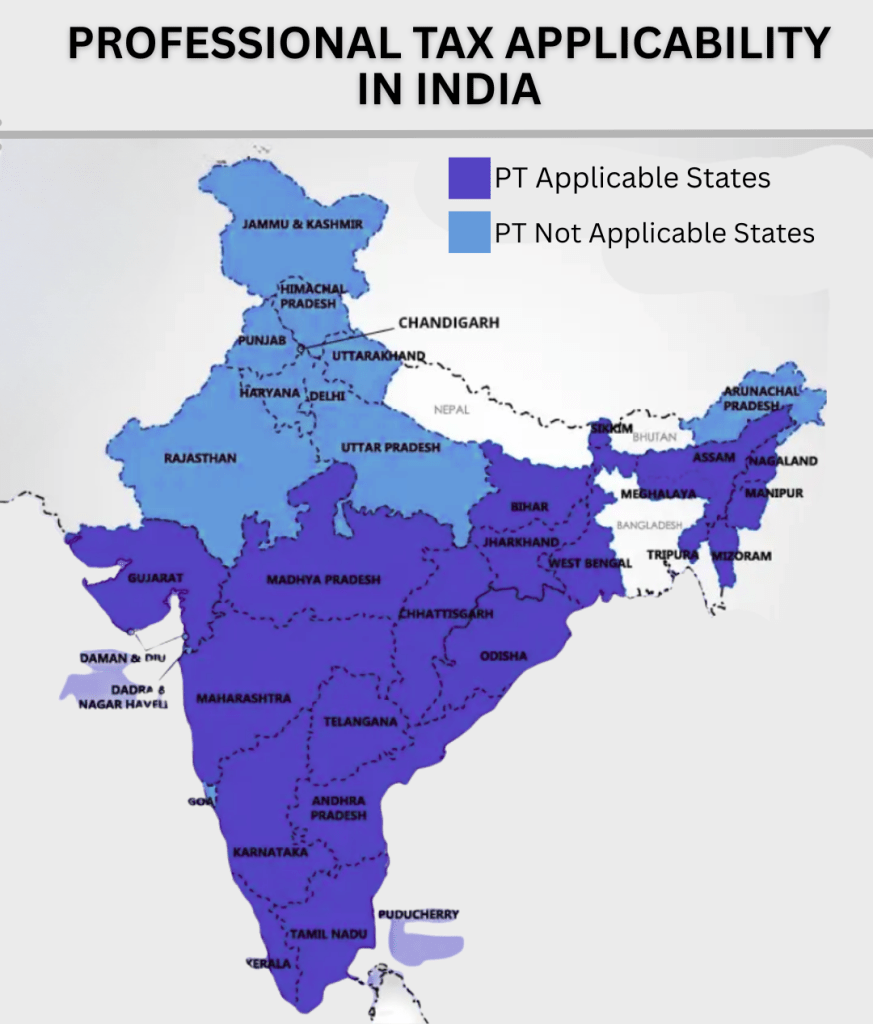
Professional Tax is not applicable across all states and Union Territories. As of FY 2026-27, the following states and UTs levy Professional Tax:
| S. No. | State / UT |
|---|---|
| 1 | Andhra Pradesh |
| 2 | Assam |
| 3 | Bihar |
| 4 | Chhattisgarh |
| 5 | Gujarat |
| 6 | Jharkhand |
| 7 | Karnataka |
| 8 | Kerala |
| 9 | Madhya Pradesh |
| 10 | Maharashtra |
| 11 | Manipur |
| 12 | Meghalaya |
| 13 | Mizoram |
| 14 | Nagaland |
| 15 | Odisha |
| 16 | Puducherry |
| 17 | Sikkim |
| 18 | Tamil Nadu |
| 19 | Telangana |
| 20 | Tripura |
| 21 | West Bengal |
Several states such as Delhi, Haryana, Uttar Pradesh, Punjab, Rajasthan, Himachal Pradesh, and Uttarakhand do not levy Professional Tax.
State-Wise Professional Tax Rates
Professional Tax rates vary from state to state. Some of the major states have the following slabs:
Maharashtra
| Monthly Salary | Professional Tax |
| Up to ₹10,000 | Nil |
| ₹10,001 – ₹15,000 | ₹175 per month |
| Above ₹15,000 | ₹200 per month (₹300 in February) |
Karnataka
| Monthly Salary | Professional Tax |
| Up to ₹15,000 | Nil |
| Above ₹15,000 | ₹200 per month |
Telangana
| Monthly Salary | Professional Tax |
| Up to ₹15,000 | Nil |
| ₹15,001 – ₹20,000 | ₹150 per month |
| Above ₹20,000 | ₹200 per month |
Andhra Pradesh
| Monthly Salary | Professional Tax |
| Up to ₹15,000 | Nil |
| ₹15,001 – ₹20,000 | ₹150 per month |
| Above ₹20,000 | ₹200 per month |
West Bengal
| Monthly Salary | Professional Tax |
| Up to ₹10,000 | Nil |
| ₹10,001 – ₹15,000 | ₹110 |
| ₹15,001 – ₹25,000 | ₹130 |
| ₹25,001 – ₹40,000 | ₹150 |
| Above ₹40,000 | ₹200 |
The tax structure may change through state budget notifications and amendments. Employers should verify current rates before payroll processing.
Who is Liable to Pay Professional Tax?
Salaried Employees
Employers deduct Professional Tax from employee salaries and deposit it with the state government.
Self-Employed Professionals
Professionals such as:
- Chartered Accountants
- Company Secretaries
- Cost Accountants
- Doctors
- Lawyers
- Architects
- Consultants
- Freelancers
must obtain Professional Tax Enrollment and pay tax according to the applicable state provisions.
Professional Tax Registration
Businesses operating in Professional Tax states are generally required to obtain:
Professional Tax Registration Certificate (PTRC)
Required for employers who deduct Professional Tax from employee salaries.
Professional Tax Enrollment Certificate (PTEC)
Required for business owners, professionals, firms, LLPs, and companies liable to pay Professional Tax on their own behalf.
Failure to register can result in penalties, interest, and compliance notices from the state tax authorities.
Due Dates and Compliance Requirements
Professional Tax compliance generally includes:
- Registration under applicable state law
- Monthly or quarterly tax payment
- Filing of Professional Tax returns
- Maintenance of employee deduction records
- Timely deposit of deducted tax
Due dates differ from state to state. Employers operating across multiple states should maintain a state-wise compliance calendar to avoid non-compliance.
Exemptions Under Professional Tax
Certain categories of individuals may be exempt from Professional Tax, subject to state-specific provisions:
- Senior citizens
- Persons with permanent disabilities
- Members of armed forces
- Parents of children with disabilities
- Certain charitable institution employees
The eligibility criteria vary across states and should be reviewed under the respective Professional Tax Acts.
Professional Tax Deduction Under Income Tax Act
Professional Tax paid during a financial year is allowed as a deduction from salary income under Section 16 of the Income Tax Act, 1961. Employees can claim this deduction while calculating taxable salary income.
Challenges for Multi-State Employers
Organizations operating across multiple states often face challenges such as:
- Different Professional Tax rates
- Separate registrations in each state
- Varying return filing frequencies
- Diverse due dates
- State-specific compliance requirements
A centralized compliance management system can help businesses avoid penalties and maintain statutory compliance.
How Sankhla Corporate Services Can Help
Sankhla Corporate Services provides end-to-end Professional Tax compliance services across India, including:
- Professional Tax Registration (PTRC & PTEC)
- State-wise Professional Tax Compliance
- Return Filing Services
- Payroll Compliance Support
- Compliance Audit and Documentation
- Multi-State PT Management
Our experts help organizations remain fully compliant with evolving state-specific Professional Tax regulations.
Conclusion
Professional Tax is a crucial statutory compliance requirement for employers and professionals operating in many Indian states. Since the applicability, rates, registration requirements, and due dates vary significantly from one state to another, businesses must stay updated and ensure timely compliance.
Whether you operate in a single state or manage a workforce across multiple locations, proactive Professional Tax compliance can help avoid penalties, audits, and legal complications while ensuring smooth payroll operations.

