
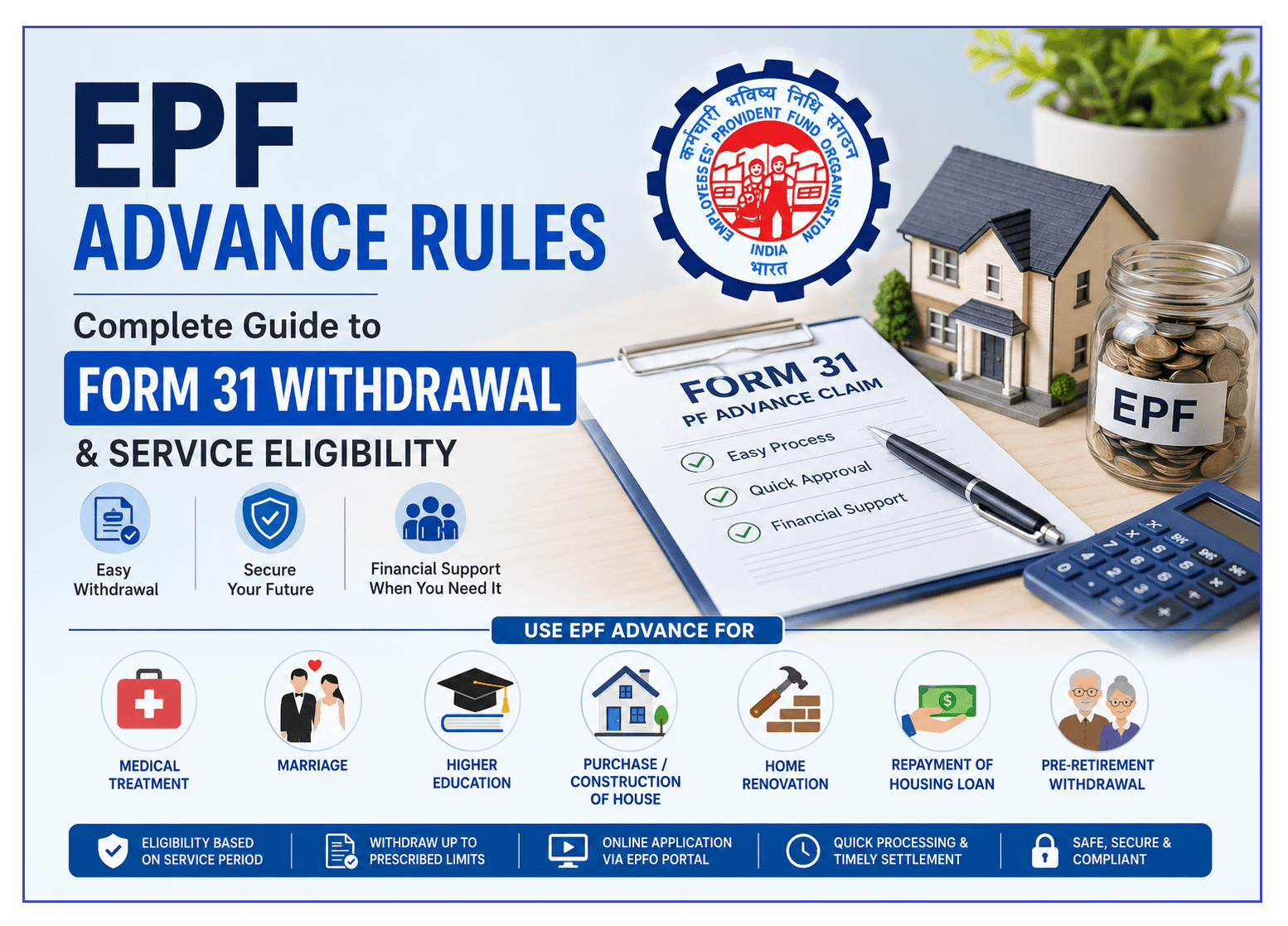
Everything you need to know about tapping your PF before retirement — updated for 2026
The Employees’ Provident Fund (EPF) is one of India’s most important social security schemes, helping employees build retirement savings while also providing financial support during emergencies. While EPF is primarily designed for retirement, members can make partial withdrawals from their EPF account under specific circumstances through Form 31, commonly known as the EPF Advance Withdrawal Form.
1. What is Form 31? The “EPF Advance”
EPF Form 31 is the application you file for a partial withdrawal or advance from your Employees’ Provident Fund account while you’re still employed. It’s also called “EPF Advance”.
Unlike Form 19 {full settlement} or Form 10C {EPS pension}, Form 31 doesn’t close your PF account. The idea is to keep EPF primarily as a retirement fund, but allow access for genuine needs.
2. When Can You Use Form 31? Reasons + Service Eligibility
EPFO allows advances only for specific purposes. Recent reforms have merged 13 earlier categories into a simpler framework, but the core reasons remain similar.
Most common withdrawal reasons & rules:
| Reason for Withdrawal | Minimum Service Required | Withdrawal Limit | Key Conditions |
|---|---|---|---|
| Medical emergency – self or family | None, anytime | Up to employee’s share + interest | Hospitalisation for serious illness. Doctor + employer certificate needed |
| Marriage – self, children, siblings | 7 years | Up to 50% of employee contribution + interest | Max 3 times in service |
| Education – post-matric for self/children | 7 years | Up to 50% of employee’s share + interest | Certificate from institution needed |
| Home purchase/construction | 5 years | Up to 90% of total balance {employee + employer} | Property in your/spouse/joint name |
| Home renovation | 5 years from house completion | Up to 12 months’ basic + DA | Only once |
| Home loan repayment | 10 years | Up to 90% of balance or loan outstanding | Paid directly to lender |
| Pre-retirement | Age 55+, within 1 year of retirement | Up to 90% of balance | One time |
| Unemployment | No minimum after leaving job | 75% after 1 month of unemployment; balance 25% after 2 months | Can withdraw full 100% in specific cases |
2026 update: EPFO has standardised eligibility to 12 months of service for most advance withdrawals, up from 7 years in some cases. Withdrawable amount now also includes employer’s contribution + interest, not just your share.
3. How Much Can You Withdraw?
- General cap: 75% of total PF corpus {employee + employer + interest} can now be withdrawn as advance.
- Purpose-specific limits still apply from the table above. Whichever is lower — the purpose limit or 75% of corpus — will be allowed.
- No minimum service for medical emergencies or unemployment.
4. Prerequisites Before You Apply
Online Form 31 claims get auto-settled faster, but only if your KYC is 100% done. Check these first:
- UAN activated and linked to mobile
- Aadhaar, PAN, Bank account verified in EPFO portal
- Date of Exit updated by employer if you’ve left the job
- Mobile linked to Aadhaar for OTP
Employer approval is waived for Aadhaar-verified online claims.
5. Step-by-Step: File Form 31 Online
Creators like Mausam Nagpal and Tech Plus Gadgets show the same flow:
- Login → https://unifiedportal-mem.epfindia.gov.in with UAN + password
- Go to Online Services → Claim {Form-31, 19, 10C}
- Verify KYC details and bank account last 4 digits
- Select “PF Advance {Form 31}”
- Choose reason, enter amount, add address
- Upload documents if asked: medical certificate, marriage card, fee estimate, etc.
- Submit with Aadhaar OTP
Processing time: 5–15 working days for most claims. Some auto-settled advances credit in 3–6 days. By March 2026, EPFO plans ATM & UPI withdrawals too.
6. Form 31 vs Form 19 vs Form 10C: Don’t Confuse Them
| Form | Use Case | Settlement Type |
|---|---|---|
| Form 31 | Partial advance while employed | Account stays active |
| Form 19 | Final PF settlement after leaving job | Account closed |
| Form 10C | EPS pension withdrawal/transfer | Pension account settled |
Pro Tip from HR experts: Transfer your PF when you switch jobs instead of withdrawing, to keep service history and avoid tax.
7. Common Rejection Reasons & Fixes
| Problem | Fix |
|---|---|
| Aadhaar not linked/verified | Update KYC on Member Portal |
| Bank mismatch | Ensure name in bank = EPFO records |
| Date of Exit not updated | Ask employer to mark exit |
| PAN not linked → TDS 30% | Link PAN; submit Form 15G/15H if eligible |
| Wrong reason selected | Match reason to documents |
8. Tax Rules on Form 31 Advance
- Form 31 advances are NOT taxable – treated as advance, not income.
- Full withdrawal before 5 years attracts TDS: 10% with PAN, 30% without.
- After 5 years continuous service, full withdrawal is tax-free.
If you’re unsure of tax impact, use a tax calculator before claiming.
9. Latest EPFO Reforms You Should Know: 2025-2026
- Uniform 12-month eligibility for all advances, simplified from 7-year rules.
- Higher withdrawal amount: 75% of corpus incl. employer share.
- Auto-settlement expanded for eligible claims.
- ATM/UPI withdrawal coming by March 2026.
- 13 categories merged to reduce delays.
10. Quick Checklist Before You Click Submit
- UAN, Aadhaar, PAN, Bank all linked & verified
- Reason matches EPFO list + you meet service criteria
- Correct documents scanned {clear PDF/JPG under 1MB}
- Bank account is active and name matches EPFO
- You’ve checked if transfer is better than withdrawal
11. Who Can Apply for EPF Advance?
- To apply for an EPF advance through Form 31, a member must generally:
- Have an active Universal Account Number (UAN)
- Complete KYC verification (Aadhaar, PAN, and Bank Account)
- Meet the service eligibility requirements applicable to the withdrawal purpose
- Have sufficient balance available in the EPF account
- Continue to remain in service (for most advance withdrawal categories)
Before applying, ensure that your KYC details are updated, service requirements are fulfilled, and the selected withdrawal category matches your actual need. Proper compliance with EPFO guidelines can significantly improve the chances of successful and timely claim settlement
Save this guide and share with colleagues who keep asking “PF kaise nikaale?”

