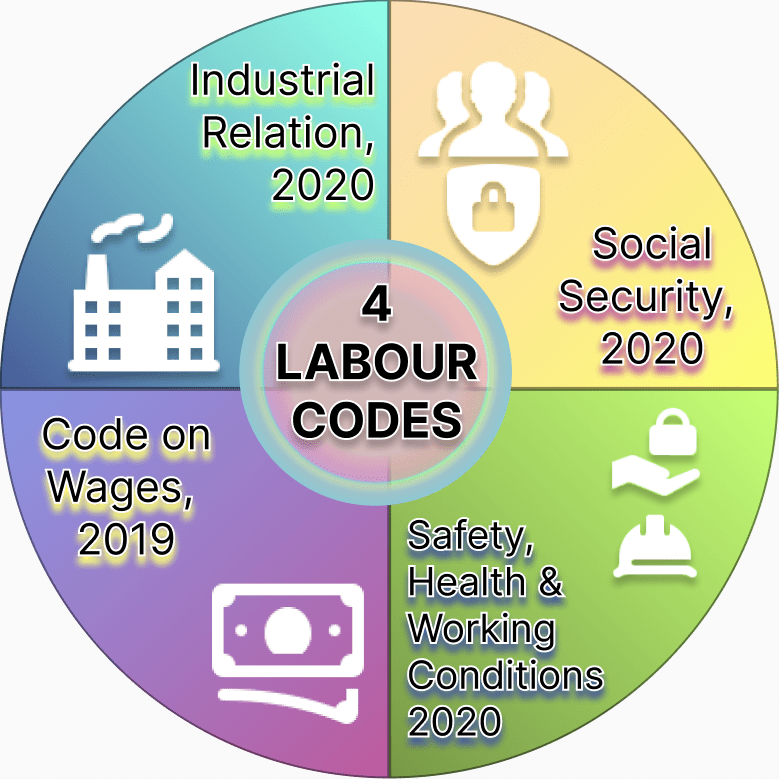
India has replaced 29 old and complicated labour laws with just four modern Labour Codes. These new laws make life easier for companies and, at the same time, give better wages, safety, and social security to workers — including delivery partners, cab drivers, and freelancers.
India is on the brink of a transformative overhaul of its labour regulatory landscape with the introduction of four new Labour Codes. These codes—the Code on Wages, 2019; the Industrial Relations Code, 2020; the Occupational Safety, Health and Working Conditions Code, 2020; and the Code on Social Security, 2020—aim to consolidate and modernize over 29 central labour laws into a unified, streamlined framework. Representing the most significant labour law reform in decades, this consolidation seeks to enhance ease of doing business, extend social security to a wider workforce, and balance the protection of workers’ rights with the needs of a dynamic economy. Their implementation is poised to reshape industrial relations, working conditions, and compliance structures across the nation.
Here’s everything explained in plain language:
1. Code on Wages, 2019 (Already in force everywhere)
This is the simplest of the four codes.
What it does:
- Every worker in India now has the right to a minimum wage, no matter which industry or state.
- Men and women must get equal pay for the same work.
- Salary must reach your bank account on time (no delays).
- Bonus rules are clearer and fairer.
- At least 50% of your total salary must be basic pay + dearness allowance (so take-home doesn’t become too low because of too many allowances).
Good for: Regular workers, contract staff, domestic helpers – basically everyone.
2. Industrial Relations Code, 2020 (The “Hiring & Firing” Code)
This code decides how companies can hire, fire, or close factories.
Big changes that matter:
- Companies can now officially hire people on fixed-term contracts (e.g., 1–3 years) and they get the same benefits (PF, gratuity, bonus) as permanent staff.
- Earlier, factories with 100+ workers needed government permission to lay off people or close down. Now this rule applies only to 300+ workers.
- Closing a factory or retrenching workers has become easier and faster for smaller and medium companies.
- If there is a dispute (like wrongful termination), it will be solved faster through tribunals.
- A new fund will help laid-off workers learn new skills.
Good for: Companies want flexibility; workers on contract get more rights.
3. Occupational Safety, Health and Working Conditions Code, 2020 (OSH Code)
This is the “safety and welfare” law.
Important points:
- Only one licence needed even if you have factories, contractors, and offices in the same state.
- Every employee gets one free health check-up every year.
- Women can now legally work night shifts if safety and transport are provided and they agree.
- Maximum working hours in a day (including overtime) = 12 hours.
- Migrant workers get journey allowance and their benefits travel with them across states.
- Factories with 250+ workers must appoint a safety officer.
Good for: Factory workers, migrant labourers, women employees, contract workers.
4. Code on Social Security, 2020 (The “Future-Ready” Code)
This is the most exciting one because it covers gig and platform workers for the first time.
What’s new:
- Delivery boys, cab drivers, freelancers on Urban Company, etc., are now officially “workers” and will get social security.
- Companies like Swiggy, Zomato, Ola, Uber will contribute 1–2% of their turnover towards a welfare fund for these workers.
- Fixed-term employees become eligible for gratuity after just 3 years (earlier it was 5 years).
- PF, ESI, maternity benefit, and gratuity rules are now the same for contract and permanent staff.
- Soon every worker will have a universal social security account linked to Aadhaar.
Good for: Gig workers, platform economy, unorganised sector, women, contract staff.
In short – Who wins?
Workers win: Higher and timely salary, safety at work, social security even if you switch jobs or work for apps, faster justice.
Companies win: Fewer licences, easier hiring/firing rules, more flexibility, less paperwork.
These four codes are the biggest change in Indian labour laws since 1947. Whether you are an employee, employer, HR professional, or a gig worker, understanding them is now essential.
For the latest state-wise rules and notifications, visit: https://labour.gov.in
Stay updated, stay compliant, and make the most of India’s new labour laws!
Where do things stand in November 2025?
By 2026, all states are expected to fully implement them.
The Wages Code is fully working across India.
The other three codes are ready in more than 30 states and union territories.