
A Complete Guide to Managing Statutory Liability in India
Category: Labour Law Compliance | Contract Labour | EPF | ESI | Principal Employer | Corporate Governance
In today’s business environment, outsourcing and contract staffing have become integral to operations across industries such as manufacturing, construction, logistics, IT, retail, healthcare, and facility management. While contractors are responsible for hiring and managing their workforce, the Principal Employer cannot overlook statutory compliance.
Under Indian labour laws, the Principal Employer carries significant legal responsibility for ensuring that contract workers receive their statutory benefits. If a contractor defaults in complying with labour laws, the liability often shifts to the Principal Employer.
This is why every organization engaging contract labour should maintain a robust Principal Employer Compliance Checklist to minimize legal, financial, and reputational risks.
Who is a Principal Employer?
A Principal Employer is the organization, company, factory, establishment, or institution that engages workers through one or more contractors to perform work within its premises or for its business operations.
Although contractors directly employ and supervise these workers, the Principal Employer remains responsible for ensuring compliance with applicable labour laws.
Examples include:
- Manufacturing companies
- IT parks
- Warehouses
- Hospitals
- Educational institutions
- Hotels
- Construction companies
- Retail chains
- Facility management companies
Why is Principal Employer Compliance Important?
The concept of Principal Employer liability is based on risk mitigation and due diligence.
If a contractor:
- Fails to register employees under EPF or ESIC,
- Pays wages below statutory requirements,
- Delays salary payments,
- Does not deposit EPF or ESI contributions,
- Violates labour law provisions, or
- Absconds without fulfilling statutory obligations,
the Principal Employer may become legally liable to:
- Pay outstanding wages
- Deposit unpaid EPF contributions
- Deposit unpaid ESI contributions
- Face penalties and prosecution
- Defend legal proceedings before labour authorities
Therefore, continuous monitoring of contractor compliance is not just a good practice—it is a legal necessity.
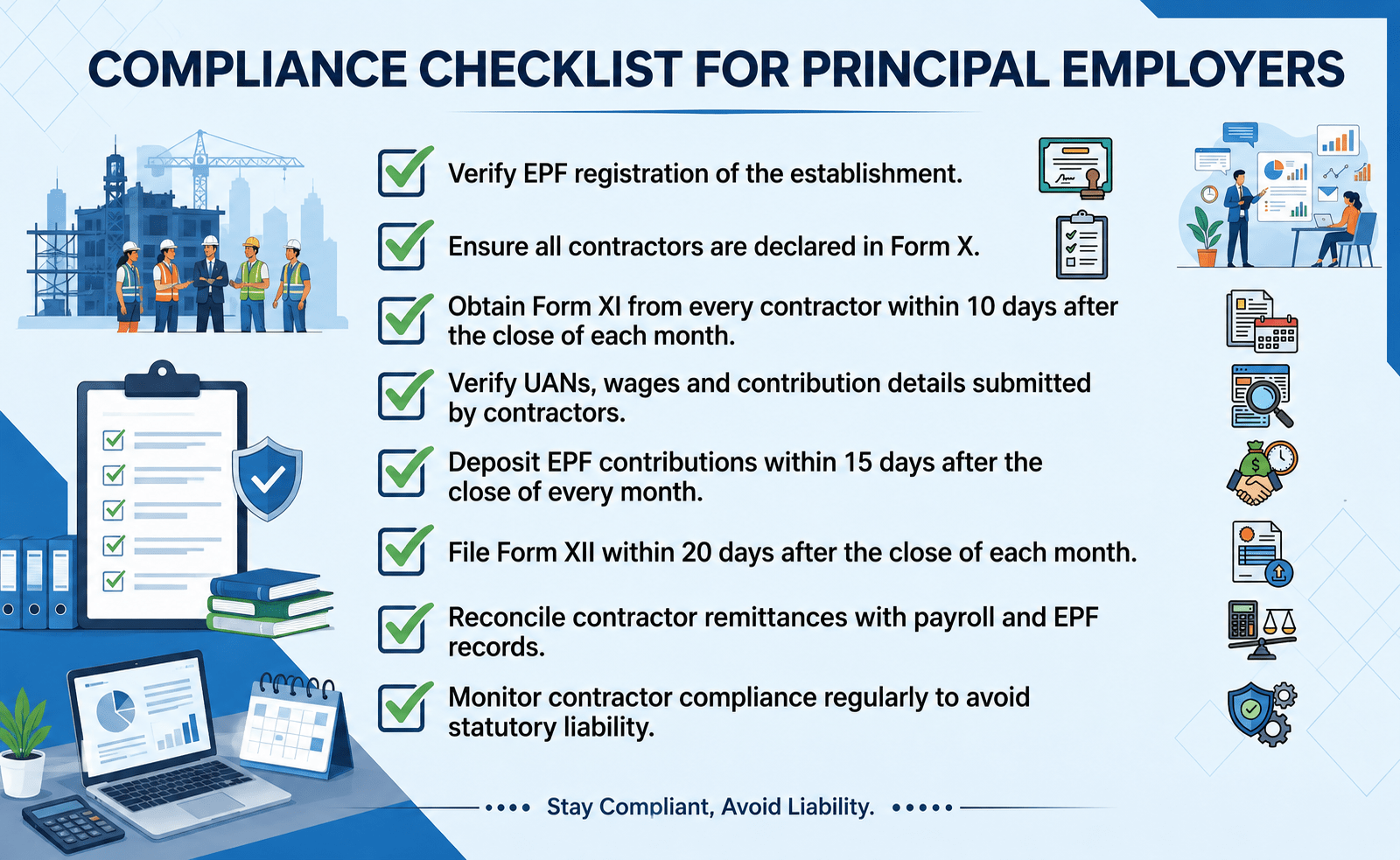
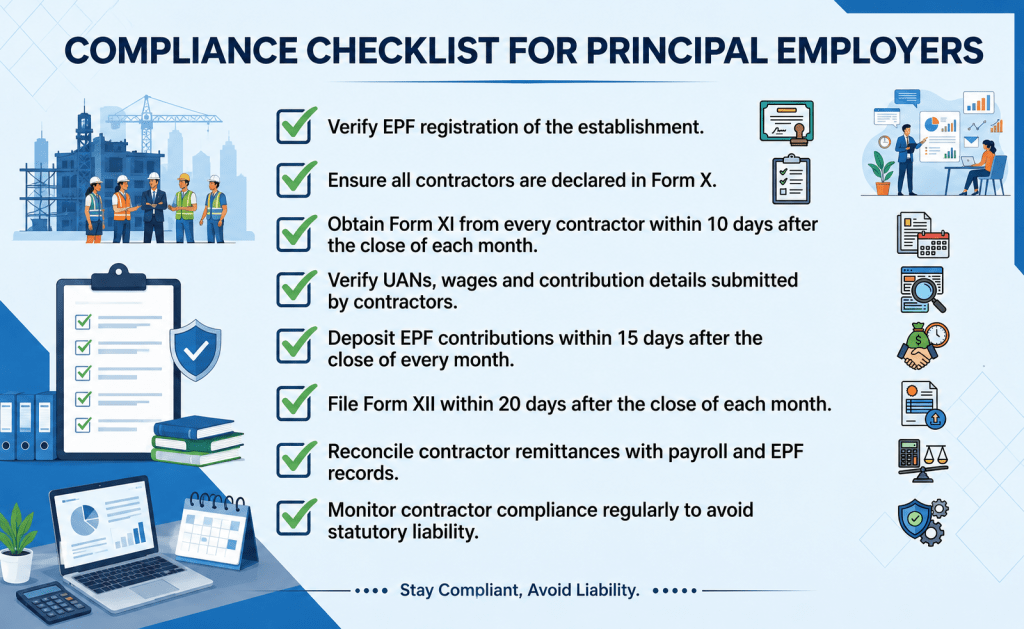
Principal Employer Compliance Checklist
Below is a practical compliance checklist that every Principal Employer should implement.
1. Verify EPF Registration of the Establishment
Before engaging any contractor, ensure that they have a valid EPF registration.
Verify:
- EPF Establishment Code
- Active EPFO registration
- Compliance history
- Employee coverage
This ensures the contractor is legally eligible to deduct and deposit EPF contributions.
2. Ensure All Contractors are Declared in Form X
Every contractor engaged by the establishment should be properly declared in Form X, wherever applicable under the relevant labour laws.
This creates an official record of contractors working under the Principal Employer.
Maintain updated records whenever:
- New contractors are appointed
- Existing contractors are replaced
- Contract values are revised
3. Obtain Form XI from Every Contractor Every Month
Principal Employers should collect Form XI from every contractor within 10 days after the close of each month.
The form helps verify:
- Number of workers deployed
- Wage details
- Attendance
- Statutory deductions
- EPF contributions
Regular collection of Form XI strengthens compliance documentation.
4. Verify UAN, Wages, and EPF Contributions
Merely collecting forms is not enough.
The Principal Employer should verify:
- Universal Account Numbers (UANs)
- Employee names
- Aadhaar linkage
- Wage details
- EPF contribution calculations
- Challans
- Electronic Challan-cum-Return (ECR)
This helps identify discrepancies before they become liabilities.
5. Ensure Timely Deposit of EPF Contributions
EPF contributions must generally be deposited within 15 days after the close of every wage month.
The Principal Employer should obtain copies of:
- EPF challans
- ECR filing acknowledgement
- Payment confirmation
- Bank transaction proof
Failure by the contractor may ultimately expose the Principal Employer to recovery proceedings.
6. Verify Filing of Form XII
Where applicable, contractors should submit Form XII within 20 days after the close of each month.
This serves as another layer of statutory compliance monitoring and record maintenance.
7. Reconcile Contractor Records with Payroll
A monthly reconciliation should compare:
- Contractor wage registers
- Attendance records
- Payroll
- EPF challans
- ECR returns
- Invoice values
This ensures that statutory deductions match actual employee deployment.
8. Conduct Periodic Contractor Compliance Audits
Compliance should never be a one-time activity.
Principal Employers should regularly audit contractors for:
- Labour licences
- EPF compliance
- ESIC compliance
- Wage payments
- Bonus compliance
- Leave records
- Statutory registers
- Labour law notices
Regular audits significantly reduce statutory exposure.
Consequences of Non-Compliance
Failure to monitor contractor compliance may result in:
- Recovery of unpaid EPF contributions
- Recovery of unpaid ESI contributions
- Payment of unpaid wages
- Interest and damages
- Labour department inspections
- Legal proceedings
- Financial penalties
- Reputational damage
- Business disruption
Best Practices for Principal Employers
To build a strong compliance framework, organizations should:
- Maintain a contractor compliance calendar.
- Verify statutory registrations before onboarding contractors.
- Collect monthly compliance documents.
- Digitize contractor records and approvals.
- Conduct quarterly labour law audits.
- Reconcile payroll with statutory returns.
- Track licence validity and renewals.
- Train internal HR, Finance, and Procurement teams on contractor compliance obligations.
How Sankhla Corporate Services Pvt. Ltd. Can Help
Managing contractor compliance across multiple locations can be complex. Sankhla Corporate Services Pvt. Ltd. provides end-to-end compliance support to help businesses minimize statutory risks and ensure adherence to Indian labour laws.
Our services include:
- Principal Employer Compliance Management
- Contract Labour Compliance
- EPF & ESIC Compliance
- Payroll Processing & Statutory Compliance
- Labour Law Audits
- Labour Licence & Registration Support
- Compliance Calendar Management
- Inspection & Notice Handling
- Labour Law Advisory Services
Conclusion
A Principal Employer cannot rely solely on contractors for statutory compliance. Indian labour laws impose a duty of oversight, making it essential to verify registrations, monitor monthly filings, reconcile statutory records, and conduct regular compliance audits.
Implementing a structured Principal Employer Compliance Checklist not only reduces legal and financial risks but also demonstrates good corporate governance and a commitment to ethical employment practices.
Organizations that proactively monitor contractor compliance are better positioned to avoid penalties, protect their workforce, and maintain long-term operational stability.
Stay Compliant. Avoid Liability. Let Sankhla Corporate Services Pvt. Ltd. help you build a robust labour law compliance framework for your organization.

