New 4 Labour Codes in India 2025 – Complete Guide to Labour Law Reforms

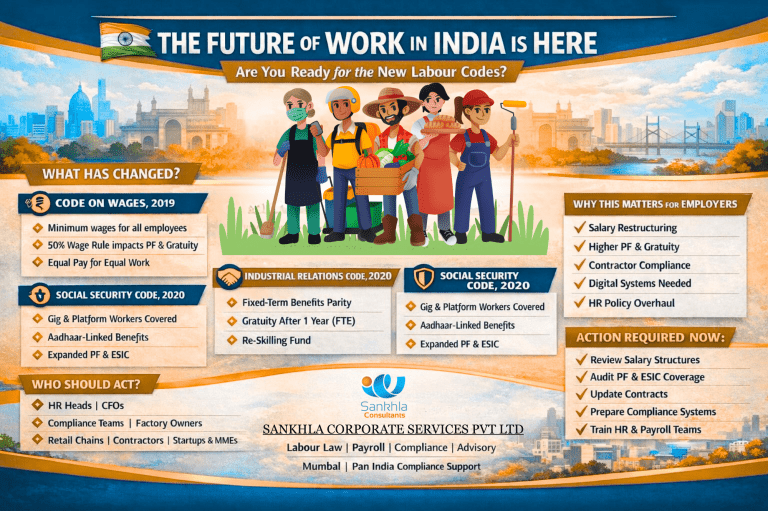
The Government of India has consolidated 29 existing central labour laws into four revolutionary Labour Codes to simplify compliance, enhance ease of doing business, and provide greater social security and protection to workers across organized and unorganized sectors. Here are the 4 New Labour Codes that are transforming India’s labour landscape: 1. Code on Wages,…

new labour codes changes

Understanding the New Labour Codes

India stands at a pivotal moment in its labour governance journey. With the introduction of the 4 Labour Codes, the country has taken a bold step toward modernizing, simplifying, and harmonizing its labour regulations. These 4 new labour codes consolidate 29 existing laws into a streamlined, progressive framework designed to support both workers and industries…

new labour codes changes

India’s Labour Transformation: Understanding the New Labour Codes and Their Impact

India is experiencing one of the most significant labour reforms in its history. The Government’s decision to consolidate 29 existing laws into 4 Labour Codes—often referred to as the 4 new labour codes—marks a transformative shift toward transparency, uniformity, and efficiency in the labour ecosystem. These changes are designed to align India’s labour landscape with…

Diwali Bonus

Four Labour Codes Implemented: A New Era of Simplified & Progressive Labour Laws in India

India has entered a historic phase in labour reforms with the implementation of all Four Labour Codes—the Code on Wages, 2019, Industrial Relations Code, 2020, Code on Social Security, 2020, and the Occupational Safety, Health and Working Conditions (OSH) Code, 2020.As notified by the Government of India, these Codes are now effective from 21st November…

Diwali Bonus

Annual Increment: Meaning, Recent Judicial Trends & Impact of Abandonment of Service

Understanding Annual Increment An annual increment is a yearly increase in an employee’s salary that becomes due once the employee completes the prescribed period of service—typically one year—with satisfactory conduct. It is not simply a reward for future performance but is considered an acknowledgment of work already performed. When the qualifying service is completed, the…

The 26 Days Minimum Wage Rules in India: A Complete Guide for Employers

The 26 Days Minimum Wage Rules in India: A Complete Guide for Employers

Minimum wage compliance is one of the most critical responsibilities for employers in India. Whether you run a factory, shop, commercial establishment, or corporate office, ensuring timely and accurate wage payments is essential to avoid penalties, legal disputes, and employee dissatisfaction.One important concept in this compliance framework is the “26 Days Minimum Wage Rule in…

POSH Compliance: Building a Safe & Inclusive Workplace

POSH Compliance: Building a Safe & Inclusive Workplace

Creating a workplace where every employee feels safe, respected, and valued is essential for any progressive organization. In India, this commitment is supported by the POSH Act (Prevention of Sexual Harassment at Workplace Act, 2013) — a crucial legislation that mandates employers to ensure a secure environment for all, especially women. In this blog, we’ll…